
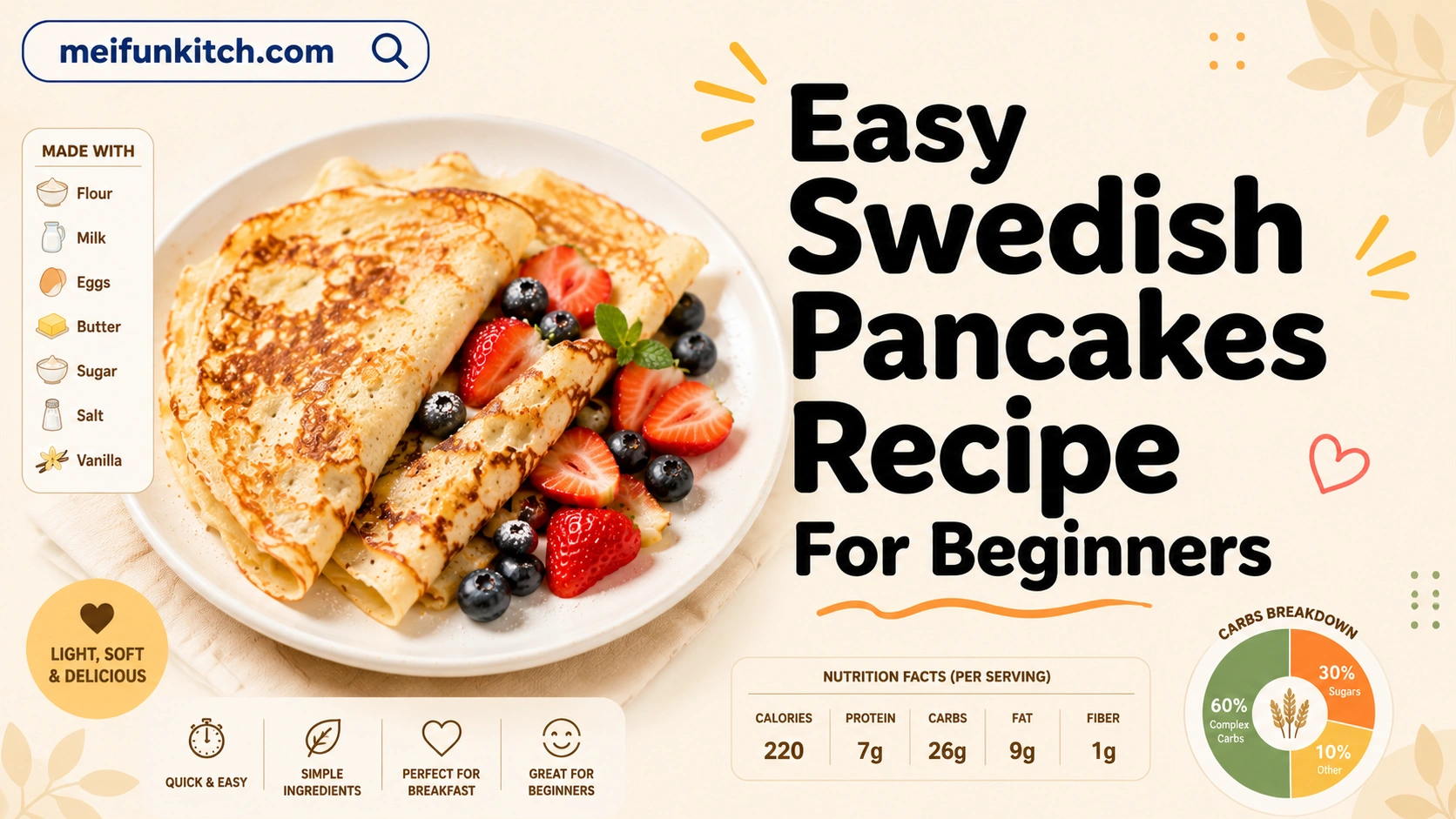
Swedish Pancakes are thin, delicate pancakes with a soft, crêpe-like texture. They use eggs, milk, flour, and melted butter for a light batter. Traditional Swedish Pancake is served with lingonberry jam and whipped cream. They contain more eggs and milk than American pancakes. This creates a tender texture with golden, lacy edges. This guide explains batter ratios, cooking methods, serving ideas, and storage tips. You will also discover healthier variations and common cooking mistakes.
In Sweden, Swedish Pancakes are called pannkakor. They are popular for weekend breakfasts and family dinners. Many families also enjoy them with pea soup on Thursdays. The batter takes only minutes to prepare. Each pancake cooks in less than a minute. Swirling the batter creates thin pancakes with crisp, lacy edges. This guide compares Swedish Pancakes, French crêpes, and plättar. It also explains batter science and simple troubleshooting tips.
Swedish Pancakes are an important part of Swedish food culture. Their history reaches back to traditional farmhouse kitchens. Eggs, milk, and flour were available throughout the year. These simple ingredients made the recipe widely popular. This guide explores the traditions behind pannkakor and Thursday pea soup dinners. It also covers gluten-free, dairy-free, and high-protein versions. Whether you want breakfast or a Scandinavian dinner, Swedish Pancake is a delicious choice. The sections below provide practical tips and detailed guidance.
What Are Swedish Pancakes? Origin and Definition
Swedish Pancakes, called pannkakor in Swedish, are thin and tender pancakes. They use eggs, milk, flour, sugar, salt, and melted butter. The batter has a smooth, pourable consistency. Swedish Pancakes are cooked in a hot, buttered skillet. The batter is swirled into a thin, even layer. This method resembles cooking a French crêpe. The edges become golden and slightly lacy during cooking. Each pancake is flipped briefly before serving. Traditional Swedish Pancakes are rolled or folded and served warm.
Swedish Pancakes originated in rural Swedish kitchens. Eggs, milk, and flour were available throughout the year. These simple ingredients created an affordable family meal. Recipes were usually shared by word of mouth. Each family developed its own batter ratio over time. Today, Swedish Pancakes are enjoyed worldwide. They appear on breakfast menus and at Scandinavian festivals. They are especially popular in Minnesota and the American Upper Midwest. Strong Nordic communities have helped preserve this traditional recipe.
Swedish Pancakes vs French Crêpes vs American Pancakes
Many home cooks confuse Swedish pancakes with French crêpes because both are thin and rolled, so a side-by-side comparison helps clarify the distinctions.
| Feature | Swedish Pancakes | French Crêpes | American Pancakes |
| Batter ratio | High egg and milk ratio to flour | Balanced flour, milk, egg, sometimes water | Higher flour ratio, leavening agents added |
| Leavening | None; texture comes from eggs | None | Baking powder or baking soda |
| Thickness | Very thin, slightly custardy | Very thin, slightly chewy | Thick and fluffy |
| Typical toppings | Lingonberry jam, whipped cream, sugar | Nutella, sugar, lemon, savory fillings | Maple syrup, butter |
| Cooking vessel | Shallow skillet or plett pan | Flat crêpe pan | Griddle |
| Cultural context | Sweden, Nordic households | France, global bistro culture | United States, Canada |
As the table shows, Swedish pancakes sit between crêpes and American pancakes in texture, offering a slightly richer, eggier bite than a crêpe while remaining far thinner and more delicate than a fluffy American stack. Additionally, Swedish pancake rarely includes baking powder, which keeps them soft and pliable enough to roll without cracking.
Swedish Pancakes vs Plättar: What Is the Difference?
Swedish Pancakes and plättar use almost the same batter. However, they differ in size, shape, and cooking equipment. Plättar are small, silver-dollar-sized pancakes. They cook in a special cast-iron plett pan. The pan has several round indentations. This allows multiple pancakes to cook at once. Swedish Pancakes are cooked one at a time. They use a wide, flat skillet. This creates a larger and thinner pancake. Traditional Swedish Pancakes are rolled or folded before serving.
Plättar are smaller and slightly thicker than Swedish Pancakes. They hold jam and whipped cream more easily. This makes them ideal for snacks and party treats. Swedish Pancakes are usually served as a complete meal. They are popular for breakfast, brunch, or light dinners. Most people enjoy Swedish Pancakes with a fork and knife.d.
Why Swedish Pancakes Are Called Pannkakor
The Swedish word pannkakor means "pan cakes" in English. The name reflects the simple pan-cooking method. Swedish Pancakes are cooked in a skillet instead of an oven. In Sweden, pannkakor describes both large and small pancakes. Context usually identifies the intended style. English speakers usually use Swedish Pancakes for the larger version. This style closely resembles French crêpes. It is also the most popular version outside Sweden.
Essential Ingredients for Authentic Swedish Pancakes
A traditional Swedish pancakes recipe relies on just six pantry staples, and understanding each ingredient's role helps explain why the texture turns out so light and custardy.
- Eggs – Provide structure, richness, and the custardy quality that distinguishes Swedish pancakes from thinner, water-based crêpes.
- Whole milk – Thins the batter so it spreads easily and keeps the finished pancake soft and delicate rather than dense.
- All-purpose flour – Adds just enough body to hold the pancake together without making it heavy or cakey.
- Melted butter – Contributes flavor, helps prevent sticking, and encourages the lacy, golden edges that Swedish pancakes are known for.
- Sugar – A small amount balances the eggy flavor and supports light browning during cooking.
- Salt – Enhances all the other flavors and keeps the batter from tasting flat or one-dimensional.
The Perfect Swedish Pancake Batter Ratio
Getting the batter ratio right is the single most important factor in achieving authentic Swedish pancakes. Most Swedish Pancakes recipes use 1 cup flour, 2 cups milk, and 2 eggs. This batter is thinner than traditional French crêpe batter. A typical crêpe recipe uses 1 cup flour, 1¼ cups milk, and 2 eggs. Swedish Pancakes contain more liquid than crêpes. This creates a lighter, softer, and more delicate texture.
The table below breaks down a standard batch alongside scaled versions for smaller or larger households.
| Batch Size | Flour | Milk | Eggs | Melted Butter | Sugar | Salt |
| Small (serves 2) | ½ cup | 1 cup | 1 egg | 1 tbsp | 1 tsp | Pinch |
| Standard (serves 4) | 1 cup | 2 cups | 2 eggs | 2 tbsp | 2 tsp | ½ tsp |
| Large (serves 8) | 2 cups | 4 cups | 4 eggs | 4 tbsp | 4 tsp | 1 tsp |
Because the batter is so liquid, many cooks blend the ingredients rather than whisking by hand, which produces a smoother, lump-free mixture and incorporates a bit of air for a lighter finished pancake. Letting the batter rest for ten to fifteen minutes before cooking also allows the flour to fully hydrate, which reduces the chance of a gritty texture.
How to Make Swedish Pancakes: Step-by-Step Instructions
Making Swedish pancakes at home takes roughly twenty minutes from start to finish once you understand the rhythm of pouring, swirling, and flipping. Follow these numbered steps for consistent, restaurant-quality results.
- Combine the wet ingredients. Whisk or blend the eggs and milk together until the mixture looks slightly frothy and has doubled in volume.
- Add the dry ingredients. Stir in the flour, sugar, and salt, mixing just until the batter is smooth and free of lumps.
- Incorporate the melted butter. Slowly pour in the cooled melted butter while whisking, which prevents it from seizing into small clumps.
- Rest the batter. Let the mixture sit for ten to fifteen minutes at room temperature so the flour hydrates fully.
- Preheat the skillet. Heat a nonstick or well-seasoned skillet over medium heat, then lightly coat it with butter or oil.
- Pour and swirl. Ladle about a quarter cup of batter into the center of the pan, then immediately tilt and rotate the pan so the batter spreads into a thin, even circle.
- Cook the first side. Let the pancake cook for roughly one minute, until the edges turn golden and start to lift slightly from the pan.
- Flip carefully. Slide a thin spatula underneath and flip the pancake, cooking the second side for only fifteen to thirty seconds.
- Stack and serve. Transfer the finished pancake to a plate, and repeat with the remaining batter, stacking with parchment paper between layers to prevent sticking.
Tips for Thin, Lacy Swedish Pancakes Every Time
Achieving that signature lacy edge on Swedish pancakes depends on a handful of small but important techniques. First, use a light hand when pouring the batter, since too much batter results in a thicker pancake that behaves more like a crêpe made incorrectly. Next, tilt the pan quickly right after pouring, because the batter begins to set within seconds and will not spread evenly if you hesitate.
Furthermore, keep the heat at a steady medium rather than high, since overly aggressive heat browns the edges before the center has a chance to set properly. Finally, wipe the pan with a thin layer of butter between each pancake rather than pouring in fresh butter every time, which prevents the pancakes from becoming greasy while still ensuring they release cleanly.
Best Toppings for Swedish Pancakes
Toppings transform simple Swedish pancakes into a genuinely memorable dish, and Swedish tradition favors a few classic pairings above all others.
- Lingonberry jam – The quintessential topping, offering a tart contrast to the pancake's mild sweetness.
- Whipped cream – Adds richness and a light, airy texture that balances the eggy batter.
- Fresh berries – Blueberries, raspberries, and strawberries bring brightness and natural sweetness.
- Powdered sugar – A simple dusting that adds sweetness without overwhelming the delicate flavor.
- Maple syrup – A non-traditional but popular option for those who prefer a familiar breakfast flavor.
- Nutella or chocolate spread – A favorite among children and anyone craving a dessert-style pancake.
Traditional Lingonberry Jam and Whipped Cream
Lingonberries are small, tart red berries from Scandinavian forests. Their jam is the traditional topping for Swedish Pancakes. Swedish Pancakes are often served with lingonberry jam and fresh whipped cream. Homemade lingonberry jam is considered the best choice. Many cooks use cranberry sauce when lingonberries are unavailable. Cranberries provide a similar tart and slightly bitter flavor. Whipped cream balances the tartness with a smooth, creamy texture. This classic combination has remained popular for generations.
Swedish Pancakes for Breakfast, Lunch, or Dinner? Cultural Traditions
One of the most interesting facts about Swedish pancakes is that they are not confined to breakfast the way pancakes often are in the United States. Instead, pannkakor frequently appears as a main course for dinner, particularly paired with a savory soup, which surprises many first-time visitors to Sweden. This flexibility makes Swedish pancakes a genuinely versatile dish that can anchor breakfast, brunch, a light lunch, or an evening meal without feeling out of place at any of them.
Thursday Pea Soup and Pannkakor Tradition
Swedish Pancakes are part of a traditional Thursday meal in Sweden. They are commonly served after a bowl of hearty ärtsoppa (yellow pea soup). This custom dates back to the medieval Catholic period. Fridays were observed as days of fasting. Families prepared filling meals on Thursday evenings instead. Swedish Pancakes provided a sweet finish to the meal. Many Swedish families still follow this tradition today. Schools and cafeterias also serve ärtsoppa with Swedish Pancakes on Thursdays.
Gluten-Free and Vegan Swedish Pancakes
Because the classic recipe leans heavily on eggs, milk, and wheat flour, adapting Swedish pancakes for dietary restrictions requires a few thoughtful substitutions rather than a simple ingredient swap. Fortunately, the basic technique of pouring, swirling, and flipping thin batter remains identical regardless of which substitutions you choose.
| Original Ingredient | Gluten-Free Substitute | Vegan Substitute |
| All-purpose flour | 1-to-1 gluten-free flour blend | Same gluten-free blend or regular flour |
| Whole milk | Same (naturally gluten-free) | Oat milk or soy milk |
| Eggs | Same (naturally gluten-free) | Flax eggs or a commercial egg replacer |
| Melted butter | Same (naturally gluten-free) | Plant-based butter or neutral oil |
Dairy-Free and Egg-Free Substitutions
When adapting Swedish pancakes for a dairy-free diet, oat milk tends to produce the closest texture to whole milk because of its natural creaminess, while soy milk offers a slightly higher protein content that helps mimic the structure eggs typically provide. For egg-free versions, a flax egg made from one tablespoon of ground flaxseed mixed with three tablespoons of water can replace one egg, though the resulting pancake will be slightly less elastic and a bit more prone to tearing. Because vegan batters lack the natural binding power of eggs, it often helps to cook these pancakes slightly smaller and handle them gently when flipping, since they will not hold together as reliably as the traditional version.
Common Mistakes When Making Swedish Pancakes
Even experienced cooks occasionally run into trouble when making Swedish pancakes, so recognizing these common pitfalls in advance can save both time and ingredients.
- Pouring too much batter – Results in a thick, crêpe-like pancake instead of the intended lacy thinness.
- Skipping the resting period – Leads to a slightly gritty texture, since the flour has not fully hydrated.
- Using high heat – Causes the edges to burn before the center sets properly.
- Not greasing the pan enough – Makes the pancake stick and tear when you try to flip it.
- Flipping too early – Tears the pancake because the underside has not yet set enough to hold together.
How to Fix Torn or Rubbery Pancakes
If Swedish Pancakes tear during flipping, check the pan and batter first. An under-greased pan often causes tearing. Flipping the pancake too early can also cause damage. Add a little more butter before cooking the next pancake. Wait 15 to 20 seconds before flipping. If Swedish Pancakes become rubbery, avoid overmixing the batter. Too much flour can also affect the texture. Whisk the batter gently and measure the ingredients carefully. These steps help produce soft, tender Swedish Pancakes. Fortunately, even imperfect, slightly torn pancakes still taste delicious once rolled and topped with jam, so a cosmetic flaw rarely ruins the dish.
Storing, Freezing, and Reheating Swedish Pancakes
Swedish pancakes store remarkably well, which makes them an excellent make-ahead option for busy mornings or meal prepping. Once cooked, allow the pancakes to cool completely on a wire rack before stacking them, since stacking warm pancakes traps steam and can make them soggy.
How Long Do Swedish Pancakes Last?
Cooked Swedish pancakes keep well in the refrigerator for several days when stored in an airtight container with parchment paper between each layer. For longer storage, the pancakes freeze beautifully for up to one month; simply wrap them individually in plastic wrap or place parchment between layers before sealing them in a freezer bag. When you are ready to eat them, reheat refrigerated pancakes in a lightly buttered skillet over medium-low heat for the best texture, though a microwave works in a pinch for a quicker option. Frozen pancakes should thaw in the refrigerator overnight before reheating, which helps preserve their delicate, tender texture rather than making them rubbery.
The table below summarizes storage guidelines at a glance.
| Storage Method | Duration | Best Reheating Method |
| Refrigerator (airtight container) | Up to 3–4 days | Skillet over medium-low heat |
| Freezer (wrapped individually) | Up to 1 month | Thaw overnight, then reheat in skillet or oven |
| Batter only (unfried, refrigerated) | 1–3 days | Whisk before cooking to re-incorporate |
Nutritional Value of Swedish Pancakes
Because the recipe relies on eggs, milk, and a modest amount of flour, Swedish pancakes offer a reasonably balanced nutritional profile compared to many other breakfast pastries. A single plain pancake, before any toppings, generally provides a moderate amount of protein thanks to the eggs and milk, along with carbohydrates from the flour and a small amount of fat from the butter. Of course, the final nutritional picture shifts considerably depending on portion size and toppings, since a stack drizzled with whipped cream and sugary jam will naturally contain more calories and sugar than one topped simply with fresh berries.
Are Swedish Pancakes Healthy?
Whether Swedish pancakes fit into a healthy diet largely depends on portion control and topping choices rather than the base recipe itself. Because the batter contains a relatively high proportion of eggs, it delivers more protein per serving than a typical crêpe or American pancake made with less egg, which can help with satiety. To make the dish even more nutritious, consider swapping half the all-purpose flour for whole wheat flour, using low-fat milk, and topping the pancakes with fresh fruit instead of syrup or sugary jam. These small adjustments preserve the traditional taste and texture while trimming excess sugar and refined carbohydrates.
The table below offers an approximate nutritional snapshot for one plain, unfilled Swedish pancake made from the standard batter ratio, to help with meal planning.
| Nutrient | Approximate Amount per Pancake |
| Calories | 90–110 kcal |
| Protein | 4–5 g |
| Carbohydrates | 9–11 g |
| Fat | 4–5 g |
| Sugar | 1–2 g |
Naturally, these figures shift once toppings enter the picture, so anyone tracking calories or sugar intake should account for jam, whipped cream, or syrup separately. Choosing fresh fruit over syrup, for example, can cut the added sugar of a serving significantly while still keeping the dish satisfying and flavorful.
Where to Find Authentic Ingredients for Swedish Pancakes
Sourcing a few specialty ingredients can elevate homemade Swedish pancakes from good to genuinely authentic, particularly when it comes to the traditional lingonberry topping. Fortunately, these ingredients have become far easier to find outside Scandinavia in recent years, thanks to growing interest in Nordic cuisine.
- Lingonberry jam – Widely available at IKEA, Scandinavian specialty grocers, and increasingly in the international aisle of larger supermarkets.
- Swedish pancake mix – Pre-measured dry mixes are sold online and at Scandinavian import shops for cooks who want a shortcut without sacrificing flavor.
- Plett pans – Available through kitchenware retailers and Scandinavian specialty stores, both online and in-person.
- Cardamom and lingonberry-flavored syrups – Specialty Nordic food shops sometimes carry these for a more adventurous topping option.
Substituting for Lingonberries When They Are Hard to Find
If lingonberries prove difficult to find locally, sweetened cranberry sauce or a mix of cranberries and a touch of extra sugar makes a reasonably close substitute for topping Swedish pancakes, since both berries share a similarly tart, slightly earthy flavor profile. Some cooks also blend cranberries with a small amount of raspberry jam to soften the tartness further, creating a topping that closely mimics the balance of sweet and sour found in traditional lingonberry preserves. Whichever substitute you choose, warming the jam slightly before serving helps it drizzle more easily over the warm, rolled pancake.
Swedish Pancake Recipe Variations Around the World
As Scandinavian immigrants settled in different parts of the world, Swedish pancakes evolved alongside similar dishes from neighboring Nordic countries, each with its own subtle twist on the same basic concept.
- Plättar (Sweden) – Small, thick, silver-dollar-sized pancakes cooked in a special multi-well pan.
- Pannukakku (Finland) – A baked, oven-set version that resembles a custardy Dutch baby more than a stovetop pancake.
- Pannekaker (Norway) – Nearly identical to Swedish pancakes, though often slightly thicker and served with sugar and syrup.
- Æbleskiver (Denmark) – Round, ball-shaped pancakes cooked in a special pan, often filled with jam or apple.
- American Swedish Pancakes – A version adapted by Scandinavian-American communities, often served with lingonberry jam imported from Sweden or purchased at IKEA.
Plättar, Finnish Pannukakku, and Norwegian Pannekaker
Comparing these regional cousins highlights just how closely related Nordic pancake traditions really are, even though each country has developed its own preferred texture and serving style. Plättar remain the closest relative to Swedish pancakes, sharing an identical batter but differing in size and cooking equipment. Finnish pannukakku, meanwhile, takes a completely different cooking approach by baking the batter in the oven, which produces a puffier, more custard-like result similar to a Dutch baby pancake. Norwegian pannekaker sit closest to the Swedish original, often distinguished only by a slightly thicker batter and a preference for sugar and syrup over lingonberry jam. Recognizing these distinctions helps clarify why recipes found online sometimes vary so much, even when they are all labeled "Scandinavian pancakes."
Equipment You Need to Make Swedish Pancakes at Home
While Swedish pancakes require only a handful of ingredients, choosing the right equipment makes a noticeable difference in how easily the batter spreads and releases from the pan. Beyond the skillet itself, a few small tools help streamline the entire process from mixing to serving.
- Blender or whisk – A blender produces the smoothest, lump-free batter in under a minute, though a sturdy whisk works nearly as well with a bit more elbow grease.
- Ladle or measuring cup – A quarter-cup measure ensures consistent pancake size from batch to batch, which helps them cook evenly.
- Thin, flexible spatula – A wide, thin spatula slides cleanly under delicate pancakes, reducing the risk of tearing during the flip.
- Parchment paper – Placing parchment between stacked pancakes prevents them from sticking together while they cool or wait to be served.
- Warming oven or plate – Keeping finished pancakes in a low oven, around 200°F, ensures the whole batch stays warm until you are ready to serve.
Choosing Between a Crepe Pan, Nonstick Skillet, and Plett Pan
Selecting the correct pan is arguably the single most important equipment decision for anyone learning to make Swedish pancakes for the first time. A dedicated crepe pan, which typically has very low or nonexistent sides, makes swirling the batter and sliding a spatula underneath significantly easier than a deep-sided pan would. However, a standard 8- to 10-inch nonstick skillet works just as well for most home cooks, since its slightly raised edges still allow enough room to tilt and spread the batter thin.
For those interested specifically in plättar rather than the larger rolled style, a plett pan is worth the investment, since its multiple shallow wells let you cook several small pancakes simultaneously rather than one large one at a time. Regardless of which pan you choose, seasoning or greasing it generously before each pancake remains essential, because Swedish pancakes are thin enough that even a small amount of sticking can cause the entire pancake to tear apart during flipping.
Savory Swedish Pancakes: Beyond Sweet Toppings
Although sweet toppings dominate most discussions of Swedish pancakes, the same thin, versatile batter also works beautifully as a base for savory fillings, particularly when served as a light lunch or dinner rather than a breakfast dish. Because the pancake itself carries only a mild, slightly eggy flavor and very little sugar when made without the sweetened version, it pairs naturally with a wide range of savory ingredients without competing for attention.
Filling Ideas With Cheese, Ham, and Vegetables
Turning Swedish pancakes into a savory meal simply requires reducing or omitting the sugar in the batter and choosing hearty, flavorful fillings. Shredded cheese, such as a mild Swedish or Norwegian variety, melts beautifully when rolled inside a warm pancake straight off the skillet. Thinly sliced ham or smoked salmon adds protein and a touch of Nordic authenticity, especially when paired with a dollop of crème fraîche or sour cream. Sautéed mushrooms, spinach, or caramelized onions also work well for a vegetarian filling, while a sprinkle of fresh dill ties the flavors together in a distinctly Scandinavian way. Because the pancake itself cooks in under a minute, assembling a savory version takes barely more effort than the traditional sweet preparation, making it an efficient option for a quick weeknight dinner.
Swedish Pancakes for Special Occasions and Celebrations
Beyond everyday breakfasts and the well-known Thursday pea soup tradition, Swedish pancakes also make regular appearances at larger Swedish celebrations and seasonal festivities throughout the year. Their simple ingredient list and quick cooking time make them practical for feeding a crowd, while their comforting, nostalgic flavor makes them a natural fit for gatherings centered on family and tradition.
Serving Swedish Pancakes at Midsummer and Other Holidays
During Midsummer, one of Sweden's most beloved holidays, Swedish pancakes often appear alongside fresh strawberries, which ripen conveniently around the same time as the celebration in late June. The bright red berries pair naturally with the pale, golden pancakes, creating a dish that feels both festive and seasonally appropriate. Similarly, many Swedish-American communities in the United States serve pannkakor at heritage festivals and church gatherings, often alongside other Nordic staples like meatballs or pickled herring, as a way of preserving cultural traditions across generations. Because the batter can be scaled up easily using the ratio outlined earlier in this guide, Swedish pancakes remain a practical choice for hosts feeding anywhere from a small family breakfast to a large community potluck.
Frequently Asked Questions About Swedish Pancakes
What is the difference between Swedish pancakes and crêpes?
Swedish pancakes contain a higher ratio of eggs and milk relative to flour than French crêpes, which gives them a slightly custardy, richer texture. Crêpes, by comparison, often include a bit of water alongside the milk and rely less heavily on eggs, producing a thinner, slightly chewier result that is commonly filled with both sweet and savory ingredients.
Can I make Swedish pancake batter ahead of time?
Yes, Swedish pancakes batter can be made in advance and stored in the refrigerator for one to three days in a sealed container or jar. Before cooking, simply give the batter a vigorous shake or whisk to re-incorporate any ingredients that have separated, since the eggs and milk naturally settle over time.
Why do my Swedish pancakes keep tearing when I flip them?
Torn Swedish pancakes usually result from an under-greased pan, flipping too early, or using a spatula that is too thick to slide cleanly underneath. Waiting until the edges look fully set and slightly golden before attempting to flip, along with using a thin, flexible spatula, typically solves this problem.
What is the best pan for making Swedish pancakes?
A wide, shallow nonstick skillet with a flat bottom works best for Swedish pancakes, since the low sides make flipping easier and the nonstick surface helps prevent tearing. Alternatively, a well-seasoned cast-iron skillet also performs well, provided it is generously buttered between each pancake.
Are Swedish pancakes the same as plättar?
Not exactly; Swedish pancakes and plättar share the same basic batter, but plättar are smaller, thicker, and cooked in a special multi-well pan designed to make several miniature pancakes at once. Standard Swedish pancakes, by contrast, are cooked one large, thin pancake at a time in a regular skillet.
What toppings go best with Swedish pancakes?
Traditional Swedish pancakes are topped with lingonberry jam and whipped cream, though fresh berries, powdered sugar, maple syrup, and even chocolate spread are all popular modern variations. The tart lingonberry jam in particular helps balance the pancake's mild sweetness, which is why it remains the classic pairing across Sweden.
Can Swedish pancakes be frozen?
Yes, cooked Swedish pancakes freeze well for up to one month when wrapped individually or layered with parchment paper inside a freezer-safe bag. For the best texture, thaw them in the refrigerator overnight before reheating in a lightly buttered skillet.
Are Swedish pancakes gluten-free?
Traditional Swedish pancakes are not gluten-free because they rely on wheat flour for structure, though a 1-to-1 gluten-free flour blend can replace the wheat flour with minimal changes to texture or flavor. Since the remaining ingredients, including eggs, milk, and butter, are naturally gluten-free, this single substitution is usually enough to adapt the entire recipe.
Can I make Swedish pancakes without a blender?
Yes, Swedish pancakes can absolutely be made without a blender, since a sturdy whisk and a bit of patience will produce a nearly identical batter. The key is whisking the eggs and milk together thoroughly before adding the flour gradually, which helps prevent lumps from forming; mixing the eggs with the flour first, then slowly adding the milk, is another effective trick for a smooth result.
What is the difference between Swedish pancakes and Danish pancakes?
Swedish and Danish cooks prepare pancakes with very similar batters and cooking methods. Danish cooks sometimes add extra sugar and often serve their pancakes with cinnamon instead of lingonberry jam. Danish cooks make Æbleskiver in a special ball-shaped pan. They often fill these round pancakes with apple or jam. Traditional Swedish Pancakes, however, stay thin, flat, and rolled before serving.

George Eliot
Author63 Published Articles
George Eliot is a passionate recipe writer and home cooking enthusiast dedicated to sharing simple, flavorful, and reliable recipes for everyday meals. With a love for fresh ingredients and practical cooking techniques, George creates easy-to-follow recipes that help home cooks of all skill levels prepare delicious breakfasts, lunches, dinners, desserts, and snacks. In addition to developing recipes, George shares helpful cooking tips, ingredient guides, and nutrition insights to inspire readers to cook with confidence and enjoy homemade food. Every recipe is carefully crafted, tested, and written with the goal of making home cooking enjoyable, accessible, and rewarding for families and food lovers alike.
EducationPostgraduate Diploma in Nutrition.
Experience5 Years.
ExpertiseWrite about Recipes, Nutrition Facts